Flat Earth Theory
The belief that the Earth is a flat disc rather than a sphere, and that all evidence to the contrary is part of a global conspiracy.
Tracking Conspiracy Theories — Old, New, Emerging, Evolving
The belief that the Earth is a flat disc rather than a sphere, and that all evidence to the contrary is part of a global conspiracy.
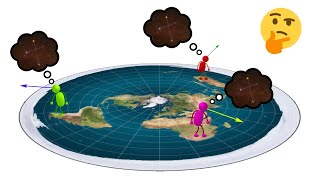
The Flat Earth theory is a scientifically disproven, archaic cosmological concept that has experienced a resurgence as a conspiracy theory in the 21st century. Proponents believe the Earth is not a spherical object, but rather a flat disk or plane. This theory generally posits that governments and scientific institutions, particularly NASA, are actively engaged in a global deception to conceal the true shape of the Earth from the public. Adherents often interpret observational phenomena and scientific data in a way that aligns with their flat Earth model, rejecting the overwhelming evidence for a spherical Earth.
The Flat Earth theory has seen a notable increase in belief and visibility since the 2010s, largely fueled by social media platforms like YouTube, which act as a content hub for proponents. This has fostered a community for the belief, leading to public debates, conventions, and the spread of misinformation. High-profile figures from popular culture, including NBA players and rappers, have publicly expressed flat Earth views, drawing significant media attention and sparking broader discussions about celebrity responsibility and misinformation in the digital age. This phenomenon highlights a public distrust of official scientific sources and the perpetuation of conspiracy theories.
The conception of a flat Earth was prevalent in many ancient societies, including the Egyptians and Babylonians, and among some early Greek philosophers. However, the idea of a spherical Earth emerged in ancient Greek philosophy with Pythagoras in the 6th century BC, and by the 4th century BC, Aristotle provided empirical evidence for a spherical Earth. Knowledge of Earth's global shape spread, and by the early Christian Church, the spherical view was widely held, despite some notable exceptions and later misinterpretations of biblical texts by certain groups during the Dark Ages. The modern flat Earth movement originated in the 19th century with English writer Samuel Rowbotham, who proposed his "Zetetic Astronomy" as a backlash against rapid scientific progress. This view was perpetuated by organizations like the Universal Zetetic Society and the later International Flat Earth Society. The theory has seen a significant resurgence in the 21st century, largely due to the internet and social media providing platforms for sharing and organizing.
From a mainstream perspective, the Flat Earth theory is considered an archaic and scientifically disproven concept. Over two millennia of scientific consensus, based on extensive empirical evidence and observations from ancient Greek mathematicians to modern satellite imagery, confirms Earth's spherical (or oblate spheroid) shape. Experts in philosophy and physics classify flat Earth beliefs as a form of science denial. Scientific models of a spherical Earth successfully explain a vast range of natural phenomena, including gravity, seasons, time zones, celestial navigation, and the appearance of different constellations from different hemispheres. Flat Earth models, in contrast, fail to adequately explain these phenomena and often rely on pseudoscientific claims, invented forces, and global conspiracy theories involving governments and scientific institutions to reconcile their views with observable reality.